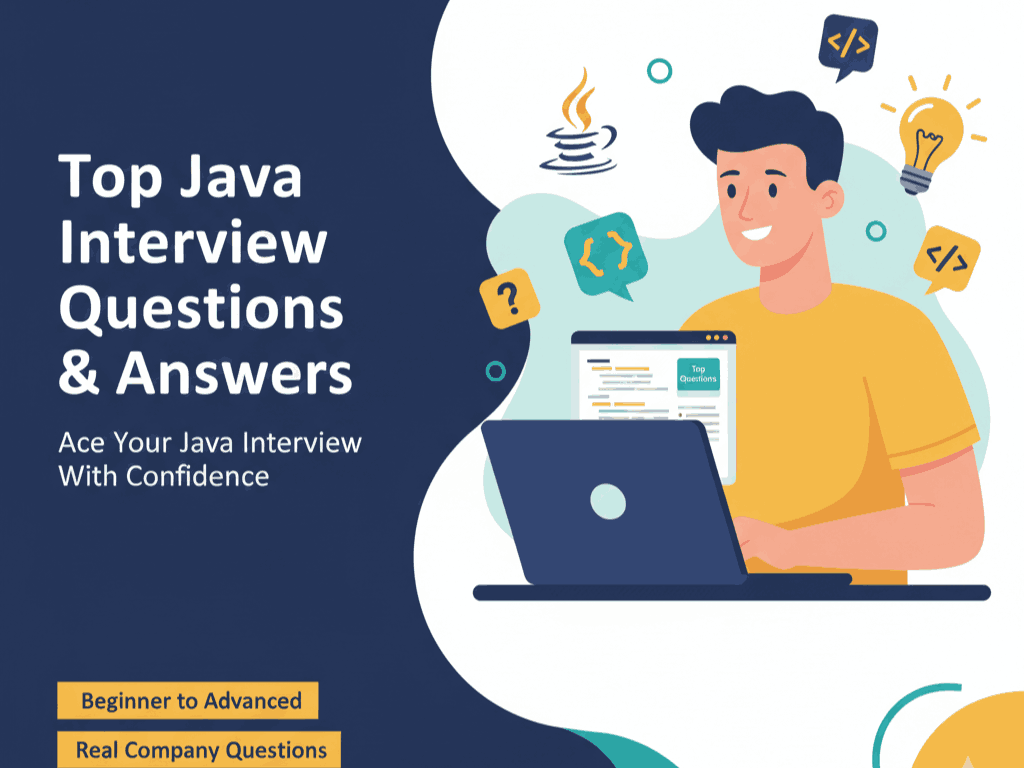
Preparing for a Java developer interview? Here are the top Java interview questions and beginner-friendly answers for freshers in 2026 — including OOP, collections, exceptions, and real project-level questions.
Java continues to be one of the most powerful and widely used programming languages, especially in enterprise applications, backend development, Android apps, and large-scale systems.
Because of its stability and strong community support, companies still prefer Java developers for backend and full-stack roles.
If you’re preparing for a Java internship, junior developer job, or IT placement, you must understand the core concepts clearly.
This blog gives you the most commonly asked Java interview questions with simple, beginner-friendly answers.
If you’re learning Java or planning to take a course, you can explore and compare institutes using SkillMap to choose the best training program near you.
1. What is Java?
Java is a high-level, object-oriented, platform-independent programming language.
Its “Write Once, Run Anywhere” nature makes it reliable and portable.
2. What are the main features of Java?
Java offers several important features such as:
- Object-Oriented
- Platform Independent
- Simple & Secure
- Robust
- Multithreaded
- High Performance (with JVM & JIT)
3. What is the JVM, JDK, and JRE?
JVM (Java Virtual Machine)
Runs Java bytecode and makes Java platform-independent.
JRE (Java Runtime Environment)
Provides libraries + JVM to run Java applications.
JDK (Java Development Kit)
JRE + compilers + tools needed for development.
4. What is OOP in Java?
OOP stands for Object-Oriented Programming.
Its four main principles are:
- Encapsulation
- Inheritance
- Polymorphism
- Abstraction
5. What is the difference between Overloading & Overriding?
Method Overloading:
Same method name, different parameters.
Happens in the same class.
Method Overriding:
Same method name & parameters in parent and child class.
Used for runtime polymorphism.
6. What is a Constructor?
A constructor is a special method used to initialize objects.
It has the same name as the class and has no return type.
Types:
- Default Constructor
- Parameterized Constructor
7. What are Access Modifiers?
Java provides four access modifiers:
- public → accessible everywhere
- private → within the same class
- protected → within package + subclass
- default → package-level access
8. What is the Collections Framework?
Collections Framework provides classes and interfaces to store and manage groups of objects.
Common interfaces:
- List
- Set
- Map
Common classes:
- ArrayList
- LinkedList
- HashSet
- HashMap
9. Difference Between Array and ArrayList
Array
- Fixed size
- Works with primitive & objects
- Faster
ArrayList
- Dynamic size
- Works only with objects
- Built-in methods like add(), remove()
10. What is Exception Handling?
Exception handling handles runtime errors using:
- try
- catch
- finally
- throw
- throws
11. Difference Between Checked and Unchecked Exceptions
Checked Exceptions
Handled at compile-time.
Example: IOException, SQLException
Unchecked Exceptions
Handled at runtime.
Example: NullPointerException, ArithmeticException
12. What is a Thread?
A thread is a small unit of processing within a program.
Java supports multithreading to perform tasks simultaneously.
Two ways to create threads:
- Extending Thread class
- Implementing Runnable
13. What is the ‘final’ Keyword Used For?
final can be applied to:
- variable → constant
- method → cannot be overridden
- class → cannot be inherited
14. What is Garbage Collection in Java?
Garbage Collection removes unused objects automatically from memory.
Benefit: No need to manually free memory.
15. What is the difference between == and .equals() ?
- == checks reference (memory address)
- equals() checks value (content)
Example:
“abc” == new String(“abc”) → false
“abc”.equals(“abc”) → true
How to Learn Java the Right Way
To learn Java properly, you need a good institute that teaches:
- Core Java
- OOP
- JDBC
- Collections
- Mini Projects
- Real-time hands-on sessions
This is where SkillMap helps you find:
- Best Java training institutes
- Course details
- Fees comparison
- Location-based centers
- Reviews from students
Selecting the right institute is the FIRST step toward a solid Java career.
Conclusion
Java is one of the most stable and career-friendly programming languages.
With the right preparation and clear understanding of concepts, any beginner can crack Java interviews confidently.
Use these top interview questions to practice daily and sharpen your concepts before attending your first interview.
👉 Want to learn Java and become job-ready?
Compare top Java training institutes now at www.myskillmaps.com — Learn smart. Build smart. Grow smart.