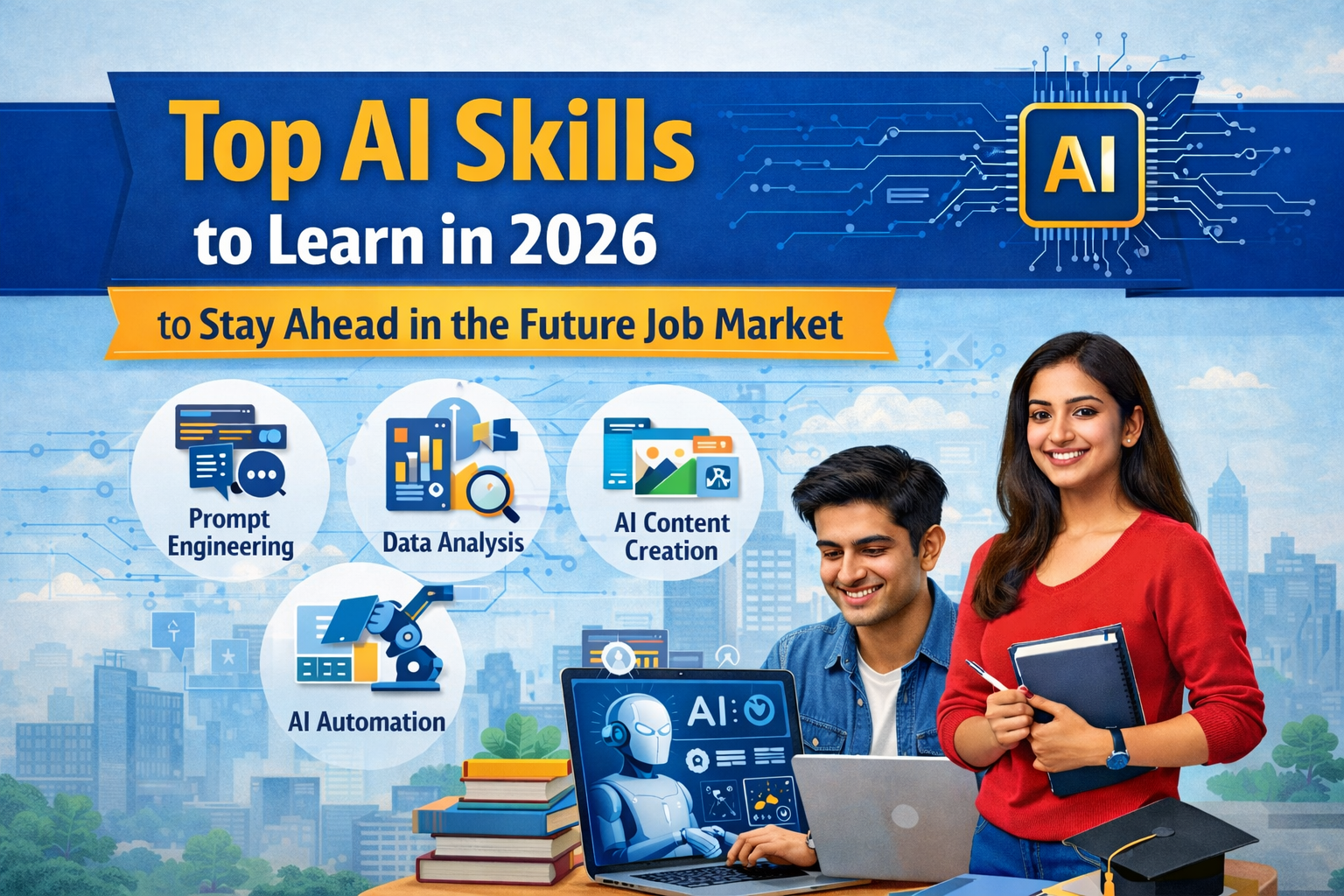
Discover the top AI skills to learn in 2026 to stay ahead in the future job market. Learn how artificial intelligence is changing careers and which AI skills students should develop for high-demand jobs.
Introduction
Artificial Intelligence is rapidly transforming the global job market. Many industries are already using AI to automate repetitive tasks, analyze massive amounts of data, and improve decision-making. As AI technology continues to evolve, the demand for professionals who understand and work with AI tools is growing faster than ever.
While some traditional jobs may change or disappear, new opportunities are emerging for individuals who learn the right skills. Students and professionals who develop AI-related skills today will have a strong advantage in the job market of 2026 and beyond.
Learning AI does not always mean becoming a deep technical expert. In fact, many careers now require a combination of domain knowledge and AI tools. From marketing to design, finance to software development, artificial intelligence is becoming an essential part of everyday work.
In this blog, we will explore the top AI skills students should learn in 2026 to stay competitive and prepare for the future job market.
Why AI Skills Are Important for the Future
The rise of artificial intelligence has created a major shift in how businesses operate. Companies now rely on AI to automate processes, improve efficiency, and gain insights from data. Because of this transformation, employers are actively searching for candidates who understand how to use AI tools effectively.
Students who learn AI skills gain several advantages. They can work faster by automating tasks, analyze information more effectively, and develop innovative solutions to complex problems. AI also enhances creativity by helping people generate ideas, designs, and content more efficiently.
Most importantly, AI skills increase career flexibility. Professionals who understand AI can work across multiple industries such as technology, marketing, finance, healthcare, and education.
1. Prompt Engineering
One of the most valuable AI skills today is prompt engineering. Prompt engineering refers to the ability to communicate effectively with AI systems by giving clear instructions that produce accurate results.
Modern AI tools such as ChatGPT, Gemini, and other large language models rely heavily on prompts. The better the prompt, the better the output generated by the AI system.
Students who master prompt engineering can use AI to write content, generate ideas, solve coding problems, analyze information, and automate workflows. This skill is useful in many professions including marketing, development, research, and design.
2. Data Analysis with AI
Data is one of the most valuable resources in modern businesses. Organizations collect large volumes of data every day, but raw data alone is not useful unless it can be analyzed and interpreted.
AI-powered data analysis tools help professionals understand trends, predict outcomes, and make informed decisions. Students who learn data analysis techniques can work in fields such as business analytics, finance, marketing, and technology.
Understanding tools like spreadsheets, dashboards, and AI-powered analytics platforms can help students turn data into meaningful insights.
3. AI Automation Skills
Automation is one of the biggest advantages of artificial intelligence. AI automation allows businesses to reduce repetitive tasks and improve productivity.
Professionals who understand automation can design workflows that connect different tools and systems. For example, marketing teams can automate campaign reports, developers can automate testing processes, and business teams can automate data updates.
Learning how automation works allows students to improve efficiency and focus on more creative or strategic work.
4. AI-Assisted Programming
Programming has always been an important skill in technology careers, but AI is now transforming how developers write code. Modern AI coding assistants can help developers write, debug, and optimize code faster than before.
Students who learn programming languages such as Python, JavaScript, or Java can use AI tools to accelerate their learning process. AI-assisted programming helps developers build applications more efficiently and solve complex problems quickly.
Even beginners can benefit from AI coding tools because they simplify the learning process and provide suggestions while writing code.
5. AI Content Creation
Content creation has evolved significantly with the introduction of AI tools. Writers, marketers, designers, and creators now use AI to generate ideas, write articles, design visuals, and edit videos.
Students interested in marketing, communication, or media can learn how to use AI tools for content creation. This includes generating blog ideas, writing social media posts, creating visuals, and developing marketing strategies.
AI content creation does not replace creativity. Instead, it enhances creativity by providing inspiration and saving time on repetitive tasks.
6. AI Design and Creative Tools
Designers are increasingly using AI-powered tools to improve creativity and efficiency. AI can generate visual concepts, suggest layouts, and automate repetitive design processes.
Students learning graphic design, UI/UX design, or video editing can benefit from AI tools that assist with image creation, layout generation, and animation.
These tools help designers experiment with new ideas and produce high-quality work faster.
7. Understanding AI Ethics and Responsible AI
As artificial intelligence becomes more powerful, it is important to use it responsibly. Ethical considerations such as fairness, transparency, privacy, and bias are becoming critical topics in AI development.
Students who understand AI ethics will be better prepared to work in organizations that value responsible technology practices. Ethical AI ensures that technology benefits society while minimizing potential risks.
How Students Can Start Learning AI Skills
Students who want to develop AI skills should start by exploring beginner-friendly tools and learning basic concepts. Understanding how AI works and how it can be applied to different industries is the first step.
Taking skill-based courses, participating in projects, and experimenting with AI tools helps students gain practical experience. Platforms like SkillMap help students discover relevant courses and compare training institutes that teach modern AI-related skills.
By exploring courses and learning opportunities, students can gradually build their knowledge and stay ahead of technological changes.
The Future Job Market and AI
The job market in the coming years will be shaped by artificial intelligence and digital transformation. Instead of replacing human workers completely, AI will change how people work.
Professionals who combine human creativity, problem-solving ability, and AI skills will be the most valuable in the workforce. Learning AI today means preparing for a future where technology and human intelligence work together.
Conclusion
Artificial intelligence is transforming industries and redefining career opportunities across the world. Students who start learning AI skills today will be better prepared for the future job market.
Skills such as prompt engineering, AI automation, data analysis, and AI-assisted creativity are becoming essential in many professions. By learning these abilities, students can increase their employability and adapt to the evolving digital landscape.
The key to success is continuous learning and staying curious about emerging technologies.
Want to learn future-ready AI skills?
Explore and compare the best skill-based courses on www.myskillmaps.com and start preparing for the careers of tomorrow.